
Light Reflection And Refraction
NCERT Solutions
Page Number: 168
#1| Define the principal focus of a concave mirror.
Answer:
The principal focus of a concave mirror is a point on its principal axis to which all the light rays which are parallel and close to the axis, converge after reflection from the concave mirror.
#2| The radius of curvature of a spherical mirror is 20 cm. What is its focal length?
Answer:
Focal length =
#3| Name a mirror that can give an erect and enlarged image of an object.
Answer:
Concave mirror.
#4| Why do we prefer a convex mirror as a rear-view mirror in vehicles ?
Answer:
We prefer a convex mirror as a rear-view mirror in vehicles because of two reasons :
- A convex mirror always produces an erect image of the objects.
- The image formed in a convex mirror is highly diminished or much smaller than the object, due to which a convex mirror gives a wide field of view of the traffic behind. A convex mirror enables the driver to view such larger area of the traffic behind him.
Solution:
R = +32 cm and
Because the image is real, so magnification m must be negative.
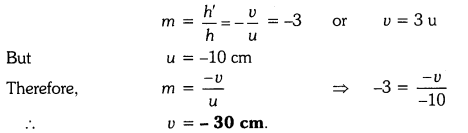
Thus the image is located at a distance of 30 cm from the mirror on the object side of the mirror.
Answer:
The light-ray bends towards the normal because the ray of light goes from a rarer medium to a denser medium.
#2| Light enters from air to glass having refractive index 1.50. What is the speed of light in the glass ? The speed of light in vacuum is 3 x 10⁸ ms-1.
Solution:
Refractive index of glass, n8 = 1.50
#3| Find out, from Table 10.3, the medium having highest optical density. Also find the medium with lowest optical density.
Answer:
From table 10.3, diamond has highest refractive index (= 2.42), so it has highest optical density.
Air has lowest refractive index (= 1.0003),
so it has lowest optical density.
#4| You are given kerosene, turpentine and water. In which of these does the light travel fastest ? Use the information given in Table 10.3.
Answer:
For kerosene, n = 1.44
For turpentine, n = 1.47
For water, n = 1.33
Because water has the lowest refractive index, therefore light travels fastest in this optically rarer medium than kerosene and turpentine oil.
#5| The refractive index of diamond is 2.42. What is the meaning of this statement?
Answer:
By saying that the refractive index of diamond is 2.42, we mean that the speed of light in diamond is lower by a factor of 2.42 relative to that in vacuum.
Page Number: 184
#1| Define 1 dioptre of power of a lens.
Answer:
One dioptre is the power of a lens whose focal length is 1 metre.
#2| A convex lens forms a real and inverted image of a needle at a distance of 50 cm from it. Where is the needle placed in front of the convex lens if the image is equal to the size of the object ? Also, find the power of the lens. , Sol. Here, u — +50 cm ..
Solution:
Here ν = +50cm
Because the real image is of the same size as the object,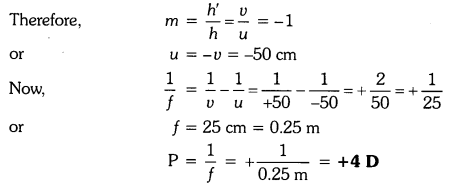
#3| Find the power of a concave lens of focal length 2 m.
Solution:
Because the focal length of a concave lens is negative,
therefore f = -2 m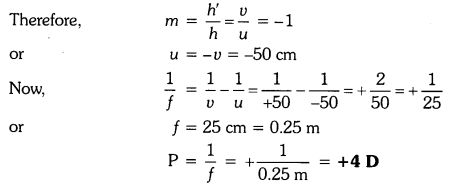
Thank You 😊
Comments
Post a Comment